

How to Analyze Your Quota Distributions

Regardless of the type of business you are in or the sales strategy you set forth or how your sales force is currently performing, as the sales leader, you should always analyze your quota distributions at the end of each performance period. And yet, shockingly, this simple exercise often gets overlooked, succumbing to the tyranny of the urgent – next quarter. In a quota seminar I facilitated recently, less than 40 percent of the executives indicated they track and review quota distributions on a regular basis. Yet hidden in last period’s performance data are insights about quota quality that the sales leader needs.
What Is Quota Attainment?
Quota attainment is a percentage reached by performing a comparative analysis of actual sales generated by an individual sales representative or collective sales team against the predetermined targets within a specific time frame. For example, if a rep’s quarterly quota is 100,000 and they generate 75,000, their quota attainment is 75%.
Every sales leader should have a routine process for analyzing quota distributions at a granular level (i.e., sub-groups such as geographies, job roles, tenure, products, accounts or industry verticals) to support an effective quota program. The quota program is critical to driving top line results and managing sales costs.
The Importance of Analyzing Quota Distributions
Sales leaders should analyze quota distributions at the end of each performance period to uncover insights hidden in performance data. This analysis can help your sales team in various ways:
- Motivation: Attainment can indicate much about your sales team’s performance and motivation. A low metric across the team can mean your team is unmotivated. Perhaps commissions are low, or they are facing other difficulties during the sales process. A low metric can indicate to sales leaders that they should address issues promptly to avoid missing the sales target.
- Goals setting: Sales leaders use average team attainment numbers to determine how much each representative is likely to sell every month. This analysis can help them set achievable goals for their representatives and forecast revenue goals more accurately.
- Strategy analysis: Tracking quota attainment rate over time can illuminate the effectiveness of different enablement tactics, sales training methods and coaching habits.
Challenges in Setting Quotas
Many sales leaders admit to finding the process of setting quotas challenging. As a result, they spend less time on the exercise and adopt the “peanut butter” technique of spreading a standard growth expectation across all teams. This approach fails to consider the previous year’s quota performance data, which is integral to developing effective methods for setting and allocating quotas.
Careful analysis of the previous quota performance data can reveal issues your sales team faces and determine the potential shape of future distributions. Skewed attainment distributions can happen due to the following:
- Top-down corporate approach with little or no collaboration
- Overallocation due to unrealistic expectations from corporate
- Favoritism toward top performers
- Poor insight into market potential
- Procrastination resulting in a rush job
- Complex sales crediting rules
What Constitutes a Good Quota Distribution?
A fact-based approach is the best way to analyze previous quota distributions. Take at least three years of performance data and create a histogram with buckets for every 10 attainment points. The results will tell you a lot about your ability to set goals and allocate quotas. Quota distributions should be a balanced, normally distributed mix of representatives who achieved outstanding pay beyond 100% of the goal and those who attained less than 100% of the goal.
Sales leaders should aim for this balance annually across regions and job roles. Good quota programs can yield such results. A good quota program involves three things:
- An appropriate allocation methodology
- A well-defined process
- A tool to manage quotas
The Long Right Tail of Quota Attainment
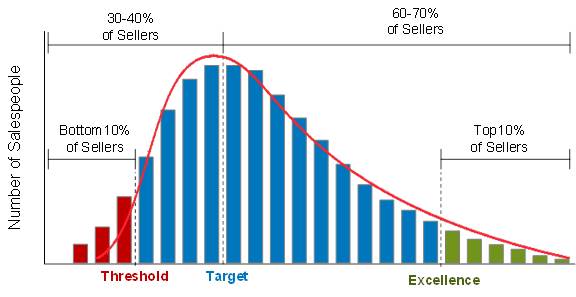
Sales rep quota attainment generally follows a positively skewed distribution, with most observations to the left of the distribution and few cases reaching the long right tail. A high skewness score indicates a longer tail, which means higher incentive compensation payouts.
When goals are set too low, the lowest-performing member will achieve a high level of attainment, leading to high incentive compensation payouts. For a balanced payout, ⅔ of sales reps should achieve or exceed quotas. Companies that don’t adhere to ⅔ attainment guidelines end up with high incentive costs and missed company goals.
Support an Effective Quota Program
Big Picture: Normal bell-shaped quota distributions are critical to maintaining a well-motivated and cost effective sales force. Moreover, if attainment distributions are not balanced, undesirable results occur such as: low morale, increased turnover, under- or over-payments of incentives. This results in a general failure to create the desired risk/reward environment. In any given period, typically ~60 percent (and this can vary slightly by industry) of reps should achieve hit plan or greater, and ~40 percent will be below goal.
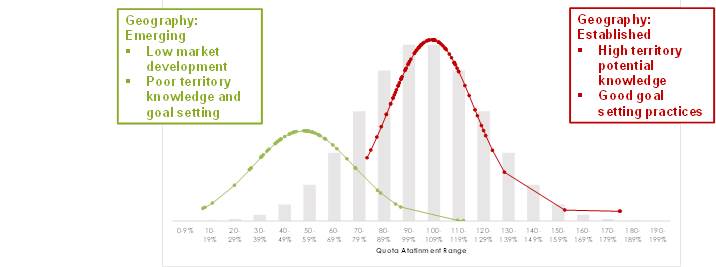
The Smaller (and more interesting) Picture: Frequent review of attainment at the sub-group level ensures consistent quota management across the various subgroups, which helps you to avoid potentially costly mistakes in quota misallocation. Here are 3 examples:
Geography
This is a common and logical first cut. Generally speaking, you should expect similar results across geographies. Factors such as market maturity (e.g., developed vs. emerging), economic growth or stability could impact quota distributions, particularly for a given period. But sustained differences in quota distributions are more often the result of inconsistent practices across geos. It’s far too common (and I suppose, easy) for sales leaders to shrug off these differences based on external factors. But they are often driven by differences in local quota allocation practices, sales crediting practices and rep deployment. The WW Sales Leader ought to examine and discuss these results with their geo leads and ensure consistent practices for quota allocation are followed.
Tenure
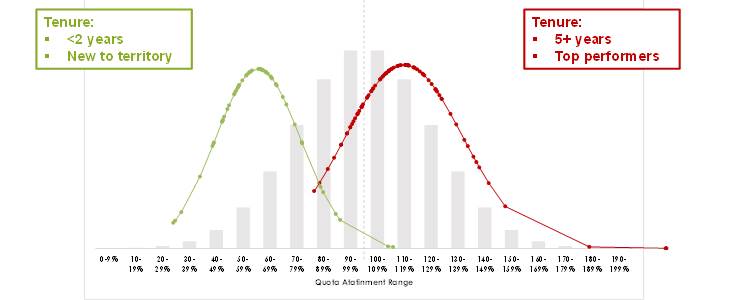
Another great but unfortunately far too rare data cut is the breakout of attainment by rep tenure. More tenured reps often have a better chance of exceeding quota. This shouldn’t be the case. While new hires have understandable ramp up times, fully on-boarded new hires should have similar quota distributions as tenured hires. But they often don’t … because of a human problem. Left unchecked and ungoverned, managers tend to allocate less than they should to tenured, strong performers, and more than they should to new hires. The Sales Leader must watch for and mitigate this practice. Good data, as per the example below, sheds light on the situation and drives the right conversation.
Job Role
Hunter, Farmer, Account Manager, Overlay, First Line Manager … Should different job roles have the same quota distributions? Maybe not, but all of these job role distributions should be normal, bell-shaped and centered around the 100 percent attainment mark. The standard deviations may be different. For example, Account Manager (i.e., “farmer”) roles in mature, well-established markets (e.g., office products) will have much smaller standard deviations (customers can only buy so many more paper clips). Meanwhile, Account Executives (i.e., “hunters”) in fast growing new markets (e.g., cloud computing) will have much larger standard deviations. Don’t try to manage the standard deviations – doing so will lead to artificially manipulating pay. Instead, test and manage for displaced, multi-modal and overall skewed results.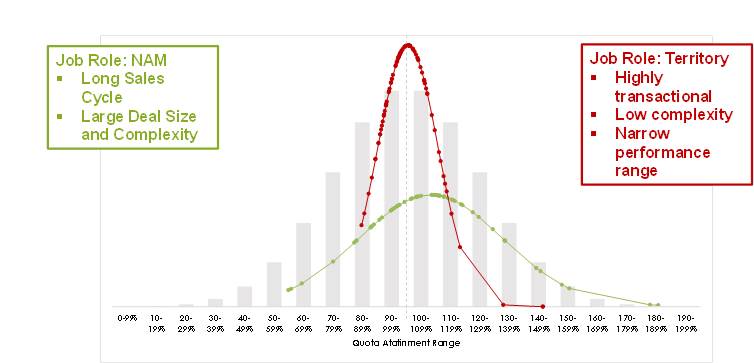
Case Study: Addressing Bi-Modal Quota Distribution
A large SaaS firm faced high compensation costs despite achieving overall growth goals. The primary reason for this was their bi-modal quota attainment distribution, which led to clusters of sales representatives performing significantly below or above quotas, resulting in inflated costs from high performers.
In this case, the bi-modal distribution was due to a misalignment between job role and compensation plan design. Alexander Group determined the organization could reduce compensation costs by around $9 million annually by normalizing the quota attainment distribution. Alexander Group emphasized the importance of aligning strategy, role design and compensation plans to mitigate such issues in sales performance.
Best Practices for Setting and Managing Quotas
Sales leaders must implement quota-setting protocols that promote equality, transparency and flexibility while aligning sales efforts with the broader organizational goals. The following are some sound general practices for establishing performance objectives:
- Use historical data to set achievable quotas.
- Align quotas with business goals.
- Use a variety of quota allocation methodologies.
- Implement robust quota management processes.
- Continuously assess and adjust quotas based on performance data.
- Monitor quota attainment closely to identify areas for improvement and inform sales strategies.
Redesign Your Quota Programs With Alexander Group
When it comes to quotas, there’s a lot a stake … a lot more than most leaders probably realize, given how few actually take the time to do the analysis correctly. Analysis of quota performance distributions yields a wide range of insights to improve the quality of your quota program and thus the performance and health of the sales force and the ROI on your sales investment. Determine which sub-groups to review based on the structure of your organization and your sense for specific problem and opportunity areas. From there, you can formulate hypotheses about root causes, dig deeper where needed and more importantly, change how you set goals next year.
Do you analyze your quota distributions? How do they look? To learn more about how to assess and redesign your quota programs, please visit our Quotas Practice.


Schedule a Quota Optimization Review
Contact one of our Business Services practice leads to see how we can support your efforts.

